Red Deer
 A native deer to Scotland, and originally a deer of forests, red deer have adapted to a life on open hills and moorland.
The red deer which we may see on the Garvellachs are pure bred, and have no genes from the similar, but introduced Sika deer, which is sometimes found on the mainland. Indeed, Sika deer can be seen at the head of Loch Seil.
A popular myth is that the number of points on a stag’s antlers indicates its age in years. This is in fact untrue. Stags can live for up to twelve years, but this is exceptional. The antlers are shed each spring, and re-grow during the summer in preparation for the Autumn rut, during which the stags compete for control of a group of hinds.
Roe Deer
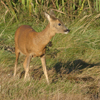 Our smallest native deer, standing just over two feet at the shoulders, the roe deer has had a chequered past throughout Scotland. At one time it was almost extinct in large parts of the country, and it is only in recent years, as a result of new forest plantations and perhaps also because of more mild winters that the deer has repopulated its former haunts. Less able to adapt to open moorland than the red deer, roe’s only tend to thrive where there is shelter and grazing provided by trees.
Owing to their size and agility they are able to evade all types of deer fencing. It is this habit which make them unpopular with foresters, and roe deer are culled to protect the forester’s commercial interests.
Being a woodland deer, and given their habit of living in small groups, they are the most difficult of deer to spot on our boat trips. They are absent from the islands, however the extensive tracts of Atlantic hazelwood that bound the mainland coast along the early part of our journey may provide an opportunity to catch a glimpse of this shy, yet beautiful creature.
Fallow deer
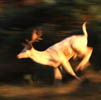 The origin of fallow deer in Britain is not fully clear, but the popular belief is that the Normans introduced them, in the Middle Ages.
Because of their relatively docile nature and the ease with which they can be contained by fencing, they were popular with deer parks. Their present distribution in Britain largely coincides with the location of former deer parks.
There is a small herd of this medium sized deer on Scarba, a small island which we shall pass during our Corryvreckan trip, and with luck we will see these deer grazing the banks.
 Dive Scotland